

Life has been extra heavy lately. We all know how heavy the world has been, but there has also been extreme heaviness in our little part of the world. A loved one in our extended family is battling a diagnosis that has a gloomy prognosis. On top of that, my husband and I have been in a valley. We have been more connected than ever in some areas, but chronic illness has a way of reminding us of the areas that need some attention. Chronic illness doesn’t care that the world is heavy or that our little part of the world is heavy. The effects of chronic illness will make themselves known at the most inopportune times.
My husband and I have known the damage that chronic illness can do to relationships, so we have sought support from trained mental health professionals at various times over the last 20+ years. We wanted to be proactive instead of reactive. We have benefitted greatly from being proactive, but that doesn’t mean that this journey is easy. We have to continuously work on ourselves and our relationship while simultaneously trying to save my life. It doesn’t seem fair on most days, but life isn’t fair.
What we are clear about is that each person in a relationship brings their own childhood traumas and nervous systems to the relationship. As a result, we are continuously tasked with healing our own individual traumas in order to bring our best to the relationship. And nothing shows a person more about their own traumas than experiencing the most difficult times in life. The difficult times put a magnifying glass right up to the areas that need attention and healing.

Regardless of the blueprint that is created by a couple, life events change it. As I have stated many times, chronic illness reshapes entire relationships. Here is how Dr. Robert Groysman describes relationship changes with long COVID, but his description can be applied to most chronic illnesses:
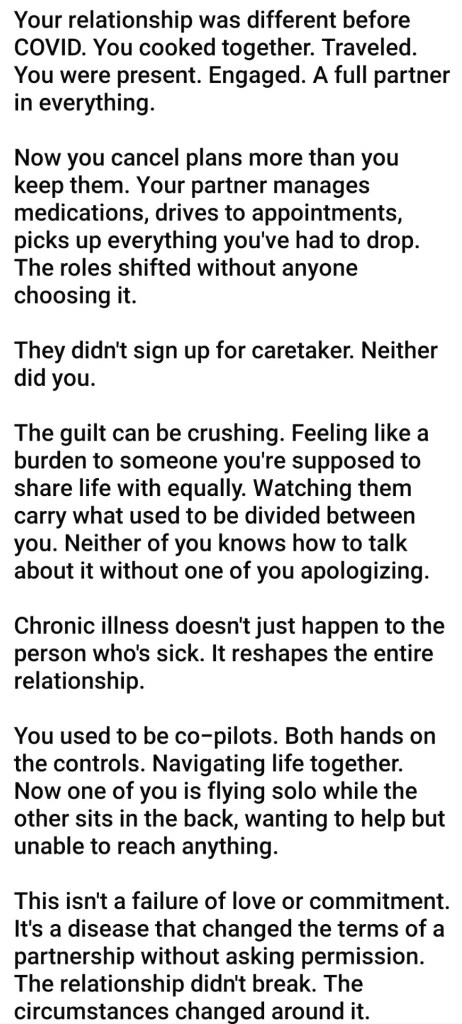
Given the similarities to our situation, I have been working on continuing to say what I need even when I feel like a burden. My husband has been working on continuing to increase his window of tolerance so that he can stay grounded and regulated as my health declines right before his eyes. In addition, the added trauma of our support system looking vastly different than the support system we thought we would have during this time has required both of us to work toward healing in this area as well. We regularly have to adjust to the capacity and skill set of our support system, and that is the opposite of what anyone would expect to be doing during the difficult times in life. You think you know who will show up for you when life is challenging, but most people react and respond differently than you would expect. We have been told that this is a common experience for people living alongside an invisible complex chronic illness, so we know that we aren’t alone in this area.
The good news is that we have both been doing the individual work and relationship work for a long time, so we are relatively good at knowing what it takes to get to the next level. Both my husband and I are intrinsically motivated and want to do the work as the need arises.

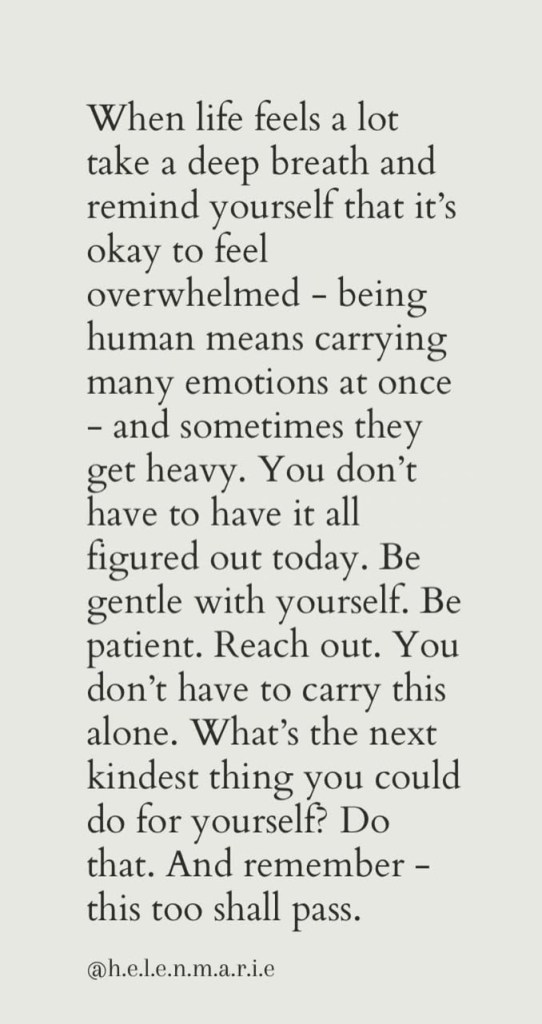
One thing that is super important for both individuals in a relationship who are living alongside an invisible complex chronic illness is self-care. It can be especially easy for caregivers to forget about themselves, but it is important to both of us that my husband doesn’t forget about himself. Jon Batiste was a guest on the IMO podcast recently, and here is how he describes the need for self-care as the caregiver:
I have also been reminding myself that this specific part of our journey is temporary. And, for me, joy and gratitude are mixed in with the heaviness.
I recently shared some of the details of the challenges that we are currently facing with one of my closest friends. Here was her response:
“Even though you do a phenomenal job of describing what you experience through your writing, this is what nobody understands or could understand until they are in it. Chronic illness impacts every single relationship in your life, and the depth of that impact is beyond fathomable. Most people don’t do the work while they are fighting for their life. You are an exception to that rule. This is why I tell you that you are a Badass.”
What I know for sure is that living alongside an invisible complex chronic illness is a team sport.

Some days, only one person in a relationship is able to keep their head above water. And, on those days, that person, along with the people in their support system who have stuck around, are there to keep both people afloat. I am beyond grateful to my husband — the love of my life — for doing the work with me to stay afloat. I am also extremely grateful to the people in our support system who have stood by us during the most difficult times. You know who you are, and we love you!
Brutal. The heaviness in the world. The heaviness in our little part of the world. Living alongside an invisible complex chronic illness.
Beautiful. Living alongside an invisible complex chronic illness. Doing the work. Self-Care. Joy and gratitude. My husband. Helping each other stay afloat. Our support system.
Just another day of . . . This Brutiful Life: The Brutal & Beautiful Moments of My Life.
 This Brutiful Life