

[Side note: This post would not have been written without my husband’s full support.]
For many years, medical providers didn’t believe me about my health situation for a variety of reasons. One of those reasons is because I mostly “look” healthy. The result of having doctors only look at what I was presenting on the outside has given me a broader perspective about how our society, as a whole, makes judgments about others. My situation is invisible to the outside world, and it is a constant reminder that we never really know what others are truly going through on the inside.
Along the same lines, my husband is a highly successful, Type A, organized person. He has a Master’s Degree in Business Administration and successfully leads a team of people in a fast-paced environment for his wage-producing job. Based on this information, one might think my husband is neurotypical and that school and success have been easy for him. According to Very Well Mind, neurotypical is a descriptor that refers to someone who has the brain functions, behaviors, and processing considered standard or typical.
However, when a person gets to know my husband in real life, they may notice some neurodivergent tendencies. According to Very Well Mind, neurodivergent is the term for people whose brains function differently in one or more ways than is considered standard or typical. Neurodivergence is a broad term that encompasses a wide range of conditions including, but certainly not limited to, Attention-Deficit/Hyperactivity Disorder (ADHD), Tourette Syndrome, Autism Spectrum Disorder, Dyslexia, Epilepsy, Dyscalculia, and some chronic mental health illnesses. A person needs to have at least one condition to be considered neurodivergent. My husband’s condition is Attention-Deficit / Hyperactivity Disorder (ADHD), and he is also likely impacted by Dyslexia and Dyscalculia. I have known that my husband’s brain processes information differently than mine from the very beginning of our relationship. But, because his neurodivergence was not detected during his childhood, he learned strategies at an early age for living in a neurotypical world. He became good at masking what is happening in his brain every day, even from me. In fact, neither of us formally categorized it as ADHD until last year when he was informed that he has ADHD by a qualified, trained professional. (And, I am a former teacher who worked with students with ADHD every day, so that tells you how good he was at masking the ways ADHD shows up in his life.)
It is important to note that just because a person is neurodivergent and processes information differently, it does not mean that they are less intelligent than someone who is neurotypical. For example, I am a former teacher, and I taught many students who were both intellectually gifted and also diagnosed with ADHD. Their brain processed information in a different way due to the ADHD, but their level of intelligence was quite high. Since their brain processed information in a different way and school was difficult for many of them, they were often viewed by the general population as unintelligent, and that couldn’t have been further from the truth. Fortunately, our society is gaining a better understanding of what it means to be neurodivergent, but we have a lot more learning to do in this area.
My husband has always known that he was different than others around him. He knew that he had to work harder to accomplish the same goals as others, but he didn’t know why. School was very difficult for him. As a child, if all you see are peers who can accomplish tasks and goals faster than you, and no one explains the concept of neurodivergence to you, you will likely start to think that you are just not very smart. And, this is exactly what happened to my husband. Unfortunately, he also had people in his life who told him that he wasn’t going to amount to anything as an adult. This exacerbated his feelings of not being smart or good enough, and it made him want to work even harder to prove those people wrong.

Neurodivergence looks different for each person, and there are a lot of misconceptions. My husband’s ADHD (and likely Dyslexia and Dyscalculia) shows up in a variety of ways, but here is a list of the primary ways:
1) Hyperfocusing — Hyperfocusing is not something that most people associate with ADHD, but it is actually very common. My husband can hone in and focus on a singular task and miss the rest of what is happening around him. For example, if he is focused on completing a task, I have a very little chance of getting his attention. There are times when I have to walk up to him and stand in front of him before he notices. Hyperfocusing also shows up in conversations and while reading lengthy texts/books. He will sometimes hyperfocus on the beginning of a conversation or section of a book and miss what comes next in the conversation or story.
2) Losing train of thought — My husband is very smart and has a ton of great ideas. However, his brain gets overwhelmed with thoughts and ideas when they come into his brain all at once. There are times when he will be talking, and he will get overwhelmed with all of his thoughts entering his brain at the same time, and he will forget what he is saying before he can communicate those thoughts in a clear and concise manner. (And, this is usually when people who don’t understand neurodivergence make judgments about his level of intelligence and make rude comments.)

(credit: Dr. Jen Wolkin)
3) Pausing to process — As my husband describes it, when someone is talking to him, the words enter his brain in a jumbled state. He then has to try to sort the words into the correct order before he can process them. Because of this, he will usually take extra time before responding in a conversation. (And, this is usually when people who don’t understand neurodivergence make judgments about his level of intelligence and make rude comments.)
4) Asking clarifying questions — Because my husband knows that his brain processes information in a different way, and because he has been judged most of his life, he is extra worried about missing something and seeming unintelligent. He will typically ask quite a few clarifying questions, or ask someone to repeat what they have said several times. He says he does this because his brain has blips in the information coming in. The best way to describe it to someone who is neurotypical is to imagine if you missed every 5th word that someone is saying to you, and you were trying to put the pieces of the conversation together on your own while missing those key words. (And, this is usually when people who don’t understand neurodivergence make judgments about his level of intelligence and make rude comments.)
5) Forgetting chunks of information — My husband does not have the best memory. He needs to complete a task with his own hands or personally write it down for him to remember it. Sometimes, he will forget a conversation we had the week before.
6) Switching up letters, words, and numbers — There are many times when we will be having a conversation involving numbers in a certain order, and my husband will tell me the numbers in the wrong order without realizing it or do a calculation backwards. He also often has a difficult time deciphering between certain letters and/or words while reading. These examples likely fall under the categories of Dyslexia and Dyscalculia. (And, this is usually when people who don’t understand neurodivergence make judgments about his level of intelligence and make rude comments.)
And, of course, stress exacerbates the difficulties he sometimes experiences due to his neurodivergence. The fact that our personal life and his professional life have been extra busy and stressful the last few years has made him have to work even harder to navigate a world that was not set up for people who are neurodivergent. It is exhausting for him.
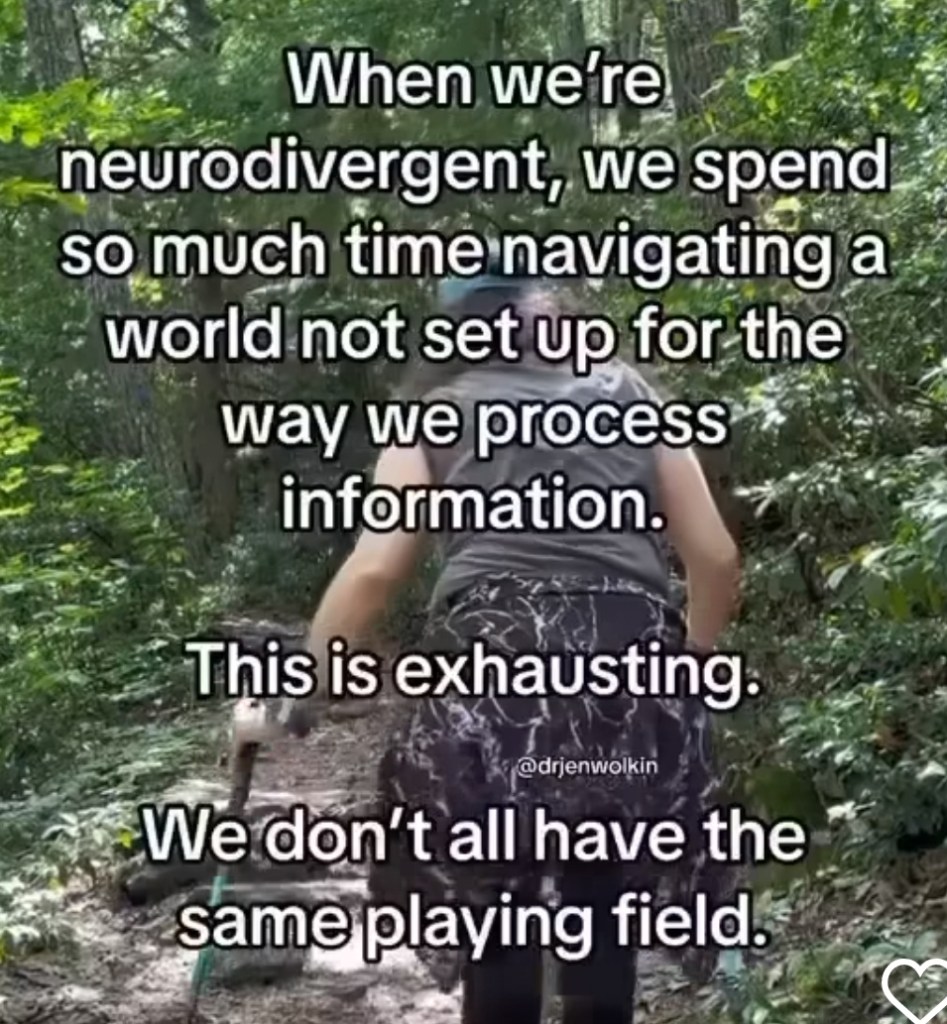
(credit: Dr. Jen Wolkin)
Because my husband didn’t have the support he needed as a child/teenager/college student going through school, he had to work extra hard to learn the material that was being presented to him. He became extremely proficient at developing success strategies throughout his childhood and adult years, and these success strategies have allowed him to learn and thrive in a neurotypical world. For example, he makes it a point to try to always focus on only one thing at a time. He also writes everything down, and he constantly utilizes the task list feature on his phone. When we have a doctor’s appointment, he tries to enter the appointment with a clear mind, and he takes detailed notes whenever he can. At work, he utilizes meeting summary emails if he feels like he missed an important detail during a meeting. At home, he knows he needs to make sure to be in the same room as me when we are having a conversation, and he makes that a priority. Without realizing what he was doing over the years, he built himself a toolbox that is full of strategies that aid in his success in all areas of his life. It is remarkable, especially considering the lack of support he received early on.
Most of my husband’s life story is not my story to tell, so I won’t be disclosing those details here. But, trust me when I say that he has beat the odds in more ways than I can count to become the person he is today. The fact that he hasn’t let his life story prevent him from being an amazing person with a strong moral compass, as well as a person who exemplifies kindness, compassion, and fierce loyalty, is remarkable beyond words. He is a Badass in every sense of the word. And, even though ADHD (and likely Dyslexia and Dyscalculia) can make his life more difficult at times, he knows that neurodivergence can be a superpower. The way his brain processes information has been an asset in various parts of our personal life and also in his professional life. He works in a technology field which can sometimes lend itself to rigid ways of thinking. He brings a different perspective to the problem solving process and often offers up unique ways to solve a variety of problems. He is highly motivated to excel in his areas of interest, and his job is one of those areas. Also, the challenges he has faced throughout his life have helped him become an even more compassionate and empathetic person and leader. He can understand and respect differences among people and teammates, and he can see the strengths that each person brings to the table. He does a wonderful job of meeting his team members where they are and helping them achieve their goals.
My husband has been by my side as we have lived alongside my invisible, complex chronic illness, and I have similarly been by his side as we have lived alongside his neurodivergence. It is not always easy, but what we know for sure is that we are a team. I remind him every day how much I love him and how much joy he brings to my life, and he reminds me how grateful he is to have someone like me who has believed in him and had his back since the day we met. He is relieved to finally have a better understanding of why he has always felt different than those around him. Additionally, he is glad that he can now release the shame he has felt from being misunderstood and judged by others as unintelligent throughout his life. Healing from the trauma he has experienced for simply being a person who is neurodivergent continues to be one of his main priorities.
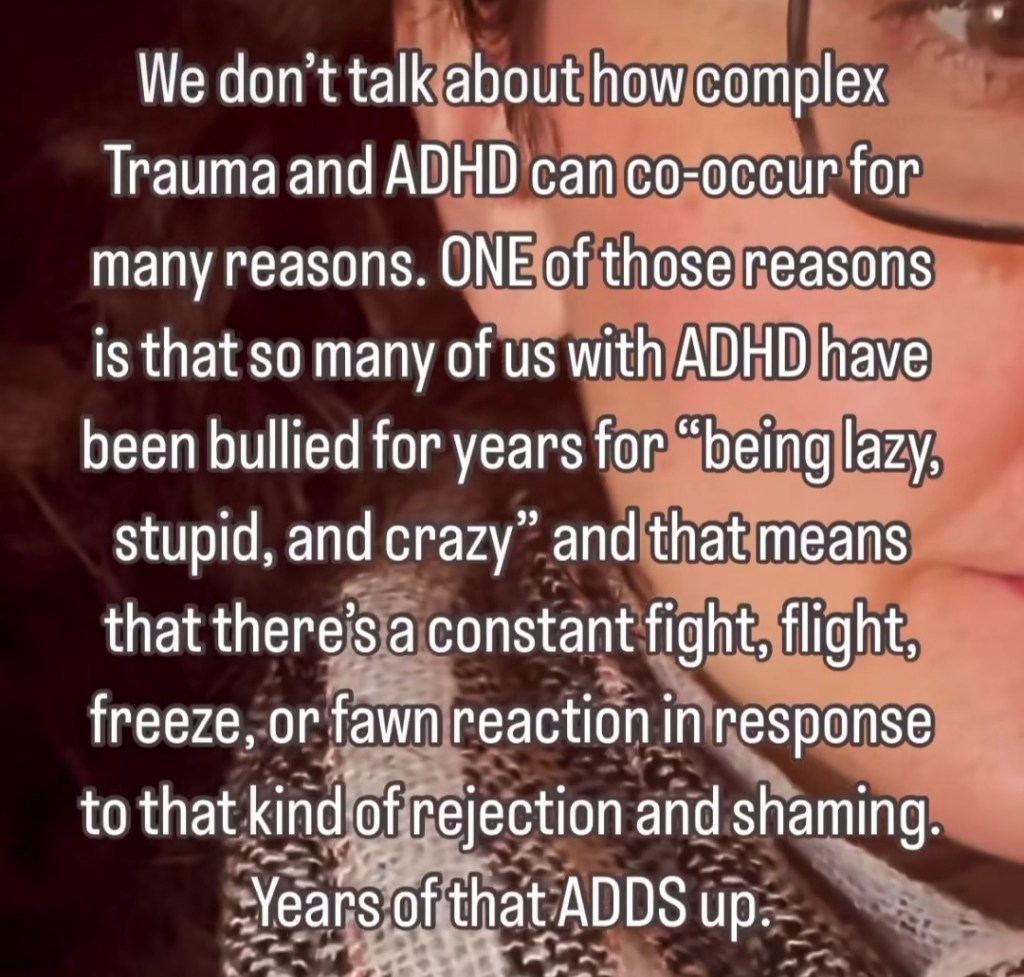
(credit: Dr. Jen Wolkin)
Let my invisible, complex chronic illness and my husband’s neurodivergence (ADHD and likely dyslexia and dyscalculia) be a reminder to us all to not judge a book by its cover. We never really know what other people are going through, and most people are going through more than what we can see from the outside looking in. It is a constant goal of mine to live my life with more compassion and less judgment, and just like everyone else, I am a work in progress.
Brutal. Judging a book by its cover. Misconceptions about neurodivergence in the general population. Being a work in progress.
Beautiful. Debunking misconceptions about neurodivergence. Reminders for us all that most people are going through more than can be seen from the outside looking in. Striving to live life with more compassion and less judgment. Being a work in progress.
Just another day of . . . This Brutiful Life: The Brutal & Beautiful Moments of My Life.
 This Brutiful Life