

My husband and I recently started watching Showtime’s documentary series Couples Therapy, which first became a hit in 2019. The docuseries is now in its third season and follows couples for six months to 1 year of weekly treatment with psychoanalyst Dr. Orna Guralnik, a faculty member at the NYU Postdoctoral Program in Psychotherapy and Psychoanalysis. The show also documents Dr. Guralnik’s weekly clinical consultation meetings with her Postdoc colleague, Dr. Virginia Goldner. MTV is starting to air the docuseries (along with Showtime), so we were able to watch a few episodes from MTV to see if we liked it. For some reason, the episodes airing on MTV were from Season 2. We were intrigued by the episodes we first watched from Season 2, so we signed up for the 7-day free trial of Paramount+ with Showtime plan. We have not watched the entire series, but so far, we like Season 2 the best. (If you haven’t watched it and are interested, we recommend starting with Season 2, and then watching Season 1 and Season 3. And, I have heard that Season 4 is being released soon.)
I think the docuseries is beneficial overall and helps to destigmatize therapy. However, I also think that therapy looks different for everyone, so don’t watch the docuseries and think it accurately depicts everyone’s experiences in therapy. For example, my husband and I were shocked by how some people treat each other in their therapy sessions. We have never come close to that level of disrespect towards each other. Our amazing therapist, who specializes in chronic illness and trauma, had previously indicated to us that the amount of love and respect we have for each other has greatly contributed to our solid foundation and is less common than we think. We now have a better understanding of this as we are watching the docuseries.
The docuseries is a reminder that many people don’t go to therapy until there is a major crisis of some kind, and that is different than how I have chosen to move through life. I have sought out both individual therapy and couples therapy at various stages of my adult life, and I strongly believe that therapy is not just for support during a crisis. Many therapists would say that seeking support in a therapeutic setting is often more beneficial when life is going well, so that you are more prepared, and have more tools, for the challenging times. I have found this to be true in my life.
I also think many people believe that therapy is only for people with a mental health diagnosis. While therapy can be great for people with a mental health diagnosis (May is National Mental Health Awareness Month), it can also be beneficial for people without a mental health diagnosis. A person doesn’t need a mental health diagnosis or need to have a deep underlying issue in order to seek therapy, but if there is mental health diagnosis or an underlying issue, therapy can help with that, too. Here are just a few of the reasons someone might seek therapy:
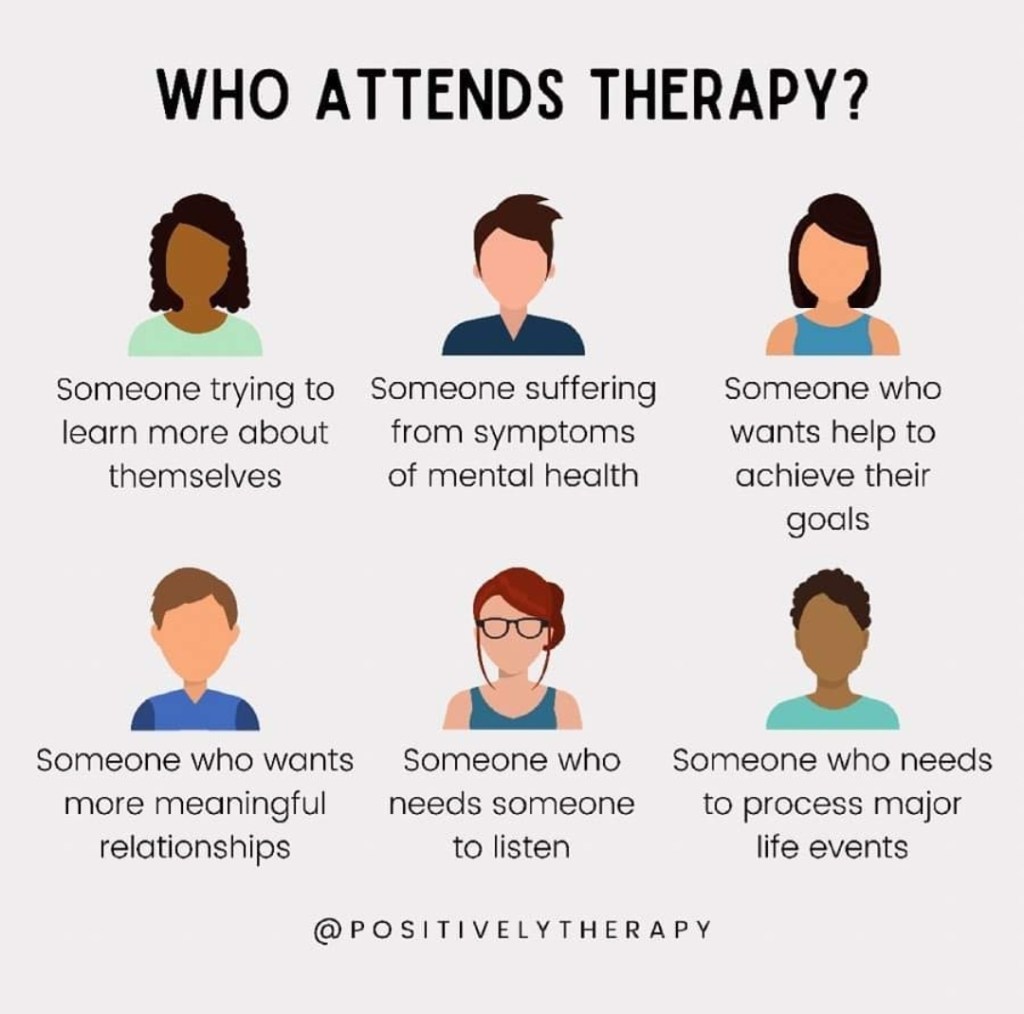
And, what I know to be true from my own life and from my former career in education is that everyone has “stuff” and could benefit from therapy. No one, and I mean no one, gets through life unscathed.
One of my former students contacted me a few weeks ago, and we caught up via email on a variety of topics. At one point, he indicated that he has sought out therapy at certain times in his life, but that my openness in my blog posts about how valuable therapy has been for me, during both good times and challenging times, has inspired him to continue seeking out therapy in the future on a more consistent and long-term basis. Given this information, my advice to him was to keep trying therapy until he finds the right therapist for him — one that matches his needs and preferred therapeutic approach. Not all therapists are equal. If he tries one and doesn’t think they are a good fit, then he should keep trying. Don’t give up. Some therapists may not be trained, or have experience, in his specific area of need. And, some therapists are more traditional in their approach and just let clients talk and figure it out for themselves by processing it out loud in their presence. I personally don’t align with this type of therapy, because I am someone who has already done the work on my own to figure out as much as I can. I want a therapist who is going to give me practical strategies and tools, resources to dive into and read, and who strives to develop a shared working relationship of care and support. Basically, the traditional model of therapy is not helpful for me. I definitely prefer a more progressive approach. However, there is a place for both therapeutic approaches, and personal preference is the key.
If individual or couples therapy is something that interests you, I highly recommend it. My husband and I truly love our couples therapy sessions. We both have always been the type of people who seek out growth and learning opportunities, and for that, I am grateful. I frequently tell our therapist how much we appreciate her, and my husband told her a few weeks ago that our therapy sessions with her are the highlight of our weeks. And, that is saying a lot since we love our life together (minus the complex chronic illness, of course. 🤣)
I understand that getting support in a therapeutic setting is a privilege in this country, and there is not a day that goes by that I am not grateful for that privilege. I know that many people don’t have access to therapy. If you want support from a qualified professional, and you don’t have the financial resources to pay for that support, some therapists are able to use a sliding scale for payment and/or have a few slots saved for people who don’t have the resources to cover the cost.
Brutal. The financial resources required to receive therapy in this country. Therapy misconceptions.
Beautiful. Destigmatizing therapy. Being married to someone who shares my belief in the importance of therapy. Our amazing therapist.
Just another day of . . . This Brutiful Life: The Brutal & Beautiful Moments of My Life.
 This Brutiful Life