

“Why don’t you use conventional treatment protocols for some of the pathogens in your body?”
“Why does your body struggle to accept some of your treatment protocols?”
“Why does treatment on your healing journey take so long?”
For my specific situation, the short answer to all of these questions is Mast Cell Activation Syndrome (MCAS). MCAS is pronounced EM-CASS or simply M-C-A-S, depending on who is speaking. I personally refer to it as EM-CASS.
Here is a list of some of the most common MCAS triggers:
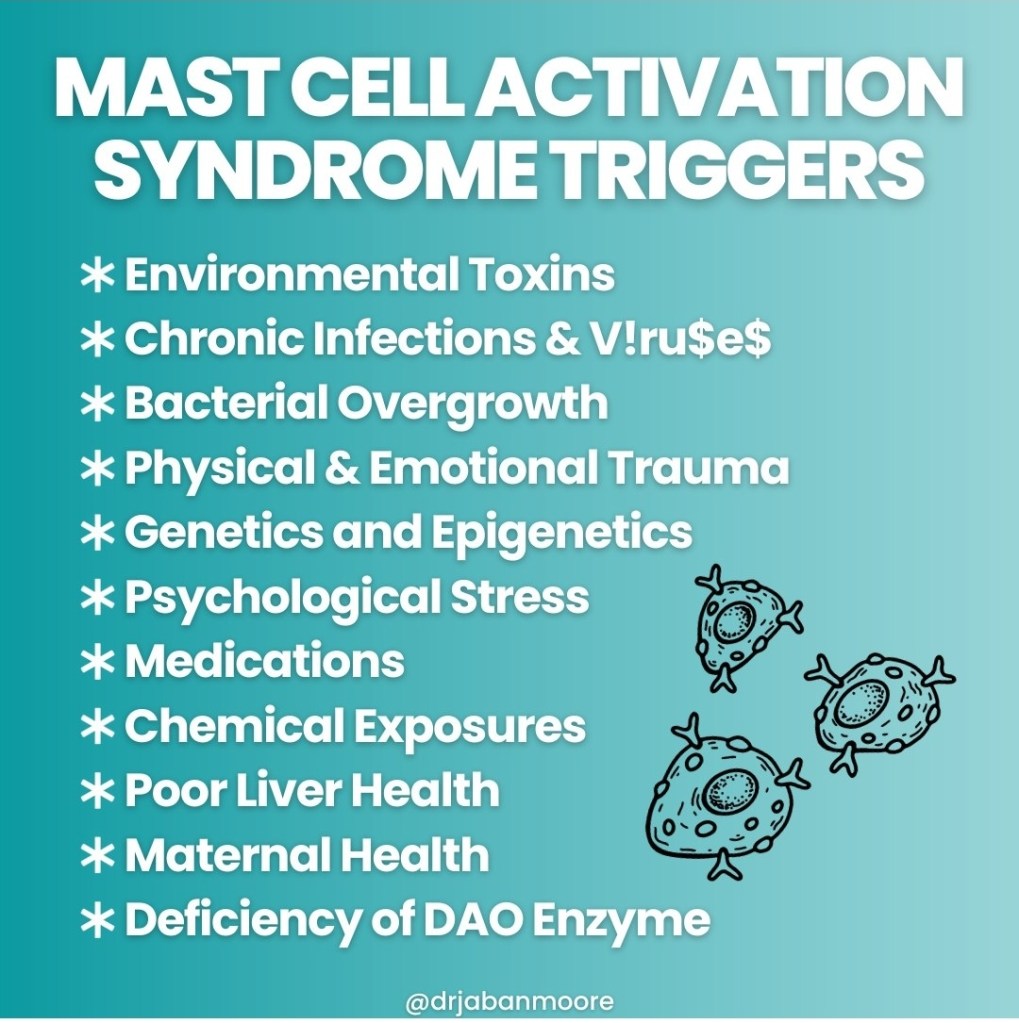
Bacterial overgrowth, chronic infections, environmental toxins (mold, etc.), and poor liver health (in my case, due to toxin overload) are MCAS triggers that have impacted me.
Here is a list of some of the top conditions associated with MCAS:

(Ignore the typo on this image.)
MCAS is very difficult to diagnose, because everyone has different symptoms and testing for it is unreliable. Instead of using unreliable testing, my doctor chooses to treat patients like me as if we have MCAS in order to help us find as much success as possible in the healing process.
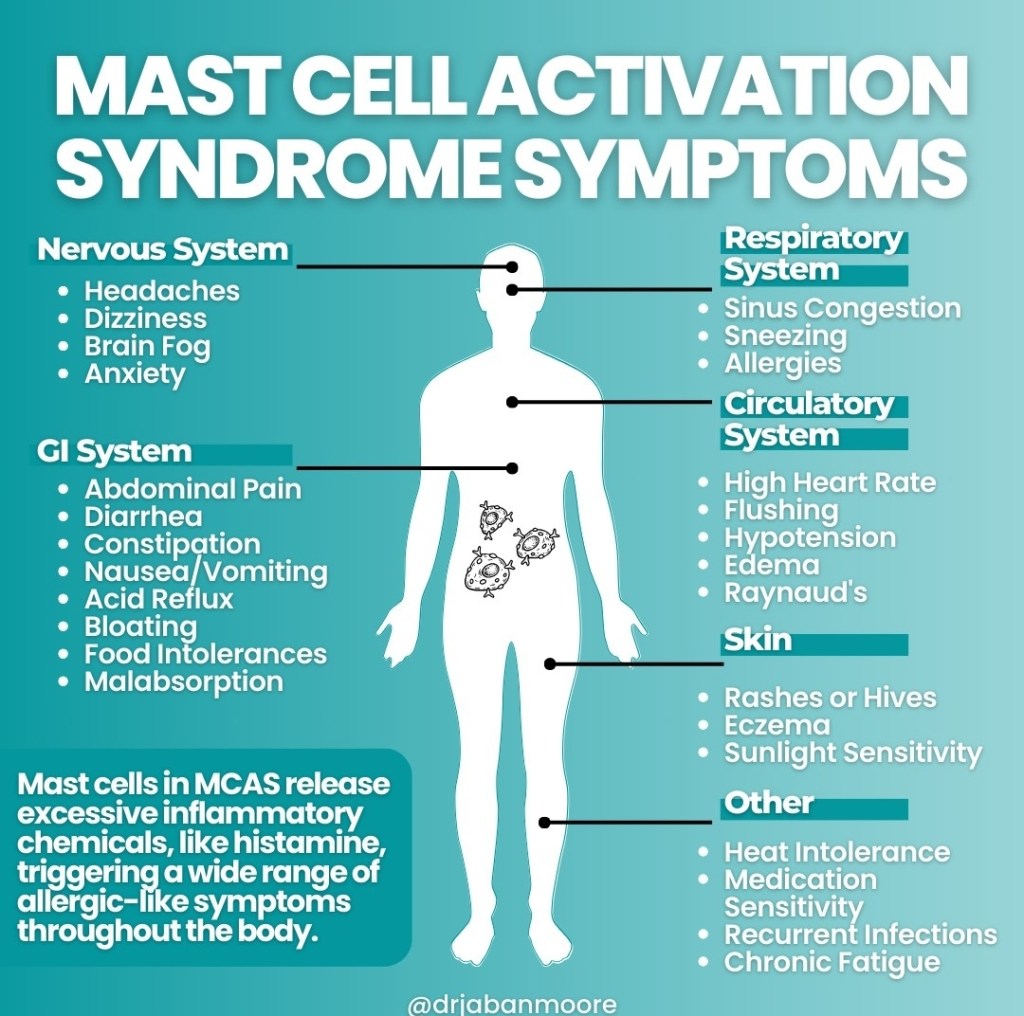
MCAS is also one of the reasons doctors frequently tell patients with complicated cases that their symptoms are all in their head. The majority of doctors don’t understand MCAS and how all of the symptoms listed below can be related.
I first heard about MCAS a few years ago, so I am not surprised that MCAS is having an effect on my healing journey. [Side note: I referred to it briefly in my Backstory #13 post.] We are in a constant balancing act of trying to attack pathogens, eliminate toxins, and improve my liver function while also trying to limit my body’s attempts to attack itself and/or the process. My immune system has been fighting pathogens and toxins for so long that it is now extra sensitive to everything. Because of this, we have to do everything in slow motion. Slow and steady is the only option that my body will accept at this point. My body is exhausted and wants to reject everything coming its way. Conventional treatments are too harsh for my body to accept, so instead, we are treating the pathogens with a more natural (and slow) approach. My only current options are homeopathic and/or supplemental approaches. The long-term hope is that my body will be less reactive once we tackle more of the pathogens and toxins in my body.
My doctor has seen this scenario over and over again with his patients, and he stated that the work I have previously done, and continue to do, to get my body ready to heal is why my situation is not the worst he has seen. He says he has patients who react severely to things like a short walk in sunlight or even tap water contamination. The things that I have done for the last 20+ years — eating clean, removing common inflammatory foods, drinking non-contaminated water, using natural cleaning products, using natural personal hygiene products, using a variety of tools to regulate my nervous system as much as possible, working on processing any and all emotional trauma through therapy, utilizing stress relieving strategies, doing Biofeedback, Neurofeedback, and acupuncture, etc. — are all things that have made my progress actually faster than most patients in my situation. I know that is hard to believe considering the snail’s pace at which we are progressing, but I agree with his assessment. He told me at our first appointment that most people in my situation are bedridden.
In my specific situation, the part of MCAS that is the most difficult is that my symptoms of MCAS can be similar to my symptoms of “Die Off” (Herxheimer reaction). Die Off symptoms occur when a treatment is killing off a pathogen at a faster rate than my body can handle. Die Off usually means that we are on the right track, but we just need to slow down. MCAS can have similar symptoms, but those symptoms can mean something different. Like Die Off, MCAS symptoms can mean that we need to slow down treatment. However, they can also mean that my body is reacting severely enough to the treatment that the treatment needs to be completely discontinued. Since the symptoms I have for both Die Off and MCAS are similar, determining next steps can be difficult.
When I have headaches, dizziness, brain fog, fatigue, nausea, and/or vomiting, we don’t always know if we need to continue with the current treatment and simply lower the dosage, or if we need to completely discontinue the specific treatment. It is really confusing and a huge mental load every single day.
The chronic infections and environmental toxins also dysregulate my nervous system, so I need to try to keep my stress levels down in order to not add to the situation. Easy-peasy, right?!? In fact, I can’t think of anything less stressful than this situation. 🤣
So, in my posts, when I say that we are needing to slow down or take a detour, all of the above is involved. I have known that the path to my healing will be a long one, so I understand it and am currently able to remain hopeful. However, I am human and can also experience the full range of emotions on any given day. Thank goodness for my supportive people. Not a day goes by without extreme gratitude for them.
Brutal. So much information. Constant confusion. A snail’s pace. The full range of emotions.
Beautiful. So much information. A doctor who has seen many patients in my situation. The work I have done to keep myself alive. The full range of emotions. Supportive people. Gratitude.
Just another day of . . . This Brutiful Life: The Brutal & Beautiful Moments of My Life.
 This Brutiful Life